Movement coaching
Use a camera to estimate arm positions and angles. Compare them with an exercise database and the person’s starting point, then give feedback on individual targets.
MOVEMENT COACHINGFABRICATION LAB / PROJECT PROPOSAL
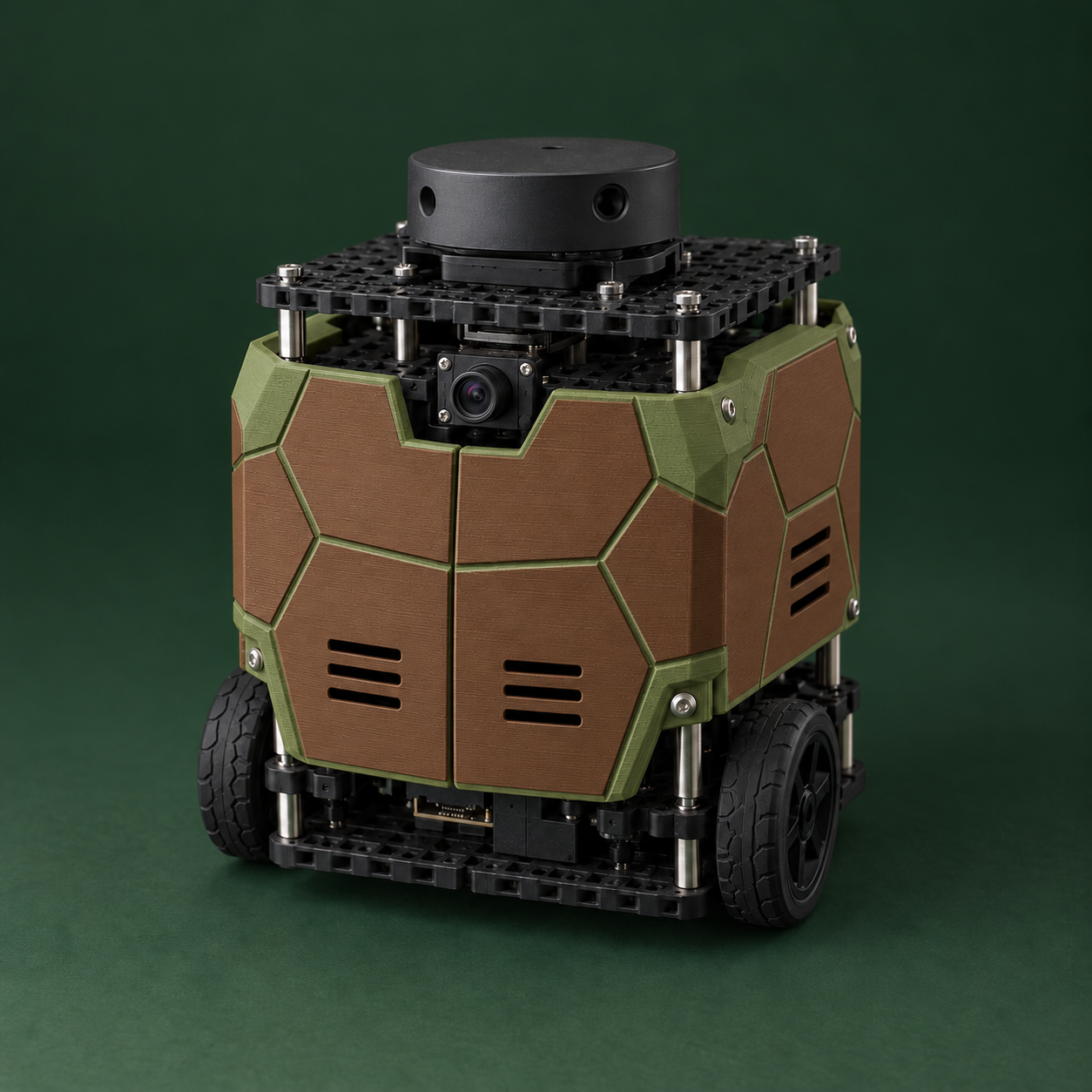
Torto uses a mobile robot to support personalised exercise between physiotherapy sessions.
For people with limited mobility, individual guidance may be hard to access between appointments. We propose feedback without attaching wearable sensors to the body.
01 / THE CORE IDEA
Movement first. Context alongside it.Use a camera to estimate arm positions and angles. Compare them with an exercise database and the person’s starting point, then give feedback on individual targets.
MOVEMENT COACHINGExplore contactless breathing measurements with mmWave radar during still rest periods between exercises.
BREATHING MONITORINGMeasure temperature and CO₂, and display alerts when agreed limits are exceeded—especially useful when uncomfortable conditions may go unnoticed.
ENVIRONMENTAL MONITORINGProposed capabilities to develop and validate. Personal targets reflect current abilities and are agreed with a physiotherapist.
02 / PROJECT SCOPE
Core prototype and optional extensionTHE CORE PROJECT
The core functions we plan to bring together.
OPTIONAL EXTENSION
Everything in Torto, plus a thermal camera.
Explore skin-temperature changes as an additional source of information during training.
Intended to support a physiotherapist’s training plan. Thermal sensing is exploratory; skin temperature is not core body temperature.
03 / OUR PROOF OF CONCEPT
One seated exercise. One individual target.Position the robot, then measure while stationary.
The robot moves to a suitable viewing position, stops, and observes one seated arm exercise. It estimates movement angles, compares them with a stored reference and the person’s baseline, and displays feedback.
Review progress across sessions and export a summary for your doctor or physiotherapist. During a still rest period, display breathing and room measurements.
Illustrative goal agreed with a physiotherapist · not live measurements
SENSOR DISPLAY / INTERACTIVE EXAMPLE
Example reading
Example reading
Illustrative estimate · still rest
Baseline 50° · agreed target 55°
Fictional readings illustrate the proposed display. The arm value comes from the example exercise; breathing is observed during rest.
SESSION REVIEW / TORTO PLUS PREVIEW
Export a session summary and the underlying readings to discuss with your doctor or physiotherapist.
Move over the image to inspect a simulated pixel.
| Session | Peak angle | From baseline |
|---|---|---|
| 01 | 50° | — |
| 02 | 51° | +1° |
| 03 | 52° | +2° |
Example history stays separate from the current sensor scenario. A measured change must exceed the system’s uncertainty before being interpreted as progress.
The CSV includes the three example sessions, the selected sensor snapshot, availability flags, demo thresholds and the synthetic thermal range. The printable summary includes this display. Downloading sends nothing to anyone.
DEMONSTRATION REPORT · FICTIONAL DATA · NO PATIENT RECORD
Upper thresholds for this fictional example only. Actual limits must be agreed for the person and setting; these are not health or safety recommendations.
Enter a temperature from 0 to 50°C and CO₂ from 300 to 10,000 ppm. These are input bounds for the demo.
No automatic breathing or exercise safety thresholds are set. A training target is not a safety limit. Changes apply only to this page until it is reloaded.
04 / PHYSICAL DESIGN
Three interpretations of the same printed shellProposed FDM covers, not validated CAD. Measure the actual robot and LiDAR, then verify scan clearance, wheel travel and camera view before printing. ROBOTIS LiDAR reference
05 / FROM IDEA TO PROTOTYPE
Prove the measurements before relying on them.Move to a suitable position and stop before observing the seated exercise.
Store a reference exercise, an initial measurement and an agreed individual target.
Estimate arm angles, display feedback and record progress across sessions.
Observe breathing while still and display room conditions. Explore thermal sensing later.
SENSOR LIMITATIONS / VALIDATION PRIORITIES
Our approach: one seated person, a stopped robot, still rest periods and a tested measurement window. Suppress unreliable estimates.
Source: TI vital-signs demo limitationsOur approach: explore exposed-skin temperature changes under consistent conditions. Keep thermal sensing optional; do not infer fever or overheating from a skin reading alone.
Source: FLIR measurement guidance · Surface visibilitymmWave: breathing-capable processing, working distance, field of view, mounting orientation, time needed for an estimate and a way to flag poor signal quality. Test against a reference during rest and with deliberate motion interference.
Thermal: whether the module provides calibrated temperature data, resolution, field of view, focus distance, accuracy, warm-up requirements and calibration. Check whether the intended skin region is large enough in the image.
No universal range or accuracy is claimed here: specifications depend on the chosen module and processing. These manufacturer references describe their own devices and demos, not validated performance of our robot.
Camera angle accuracy, room-sensor placement and consent for session recording also remain prototype checks.
What we need to test: angle accuracy · camera placement · breathing reliability · useful feedback · sensor integration